
What is a freeform murder mystery game?
If you’ve played a traditional murder mystery party before, you may be surprised by how different a freeform murder mystery feels.

Instead of progressing through a series of scripted rounds or courses, a freeform murder mystery unfolds naturally. Players decide who to speak to, what questions to ask and which clues to investigate. Every conversation can reveal new information, create unexpected alliances or expose hidden motives.
The result is a party that feels less like following a script and more like stepping into a movie where everyone has their own secrets.
Whether you’re planning a birthday party, dinner with friends or a fundraising event, this guide explains what freeform murder mystery games are, how they work and whether they’re the right choice for your group.
What does “freeform” mean?
In a freeform murder mystery, every guest plays a character with their own background, secrets and objectives.
Rather than waiting for the next round of the game to begin, everyone is free to move around, mingle and investigate throughout the evening. Players choose which conversations to have and which leads to follow.
You aren’t expected to perform from a script or invent a theatrical performance. Instead, you’re simply responding as your character would, using the information in your character booklet.
Think of it as taking part in the story rather than watching it unfold.
(And if you’re wondering where “freeform” comes from, check out Why did we call ourselves Freeform Games?)
How does a freeform murder mystery work?
Although every game is different, most follow the same broad pattern.
Before the party
The host:
- Chooses a game
- Reads the game and assigns characters to guests
- Prints the game materials
- Prepares the venue and any refreshments
Players:
- Receive their character information and become familiar with their background and objectives
- Decide on a costume for the game
- Don’t reveal in-game secrets to other players!
During the party
Once everyone arrives, the mystery begins as the host welcomes them to the party, sets the scene, and introduces all the characters.
When the game starts, guests start talking to each other. Character packs often include “Suggested first moves” with simple actions (For example, “Find out if Diana knows where the will is.”) to get players started.
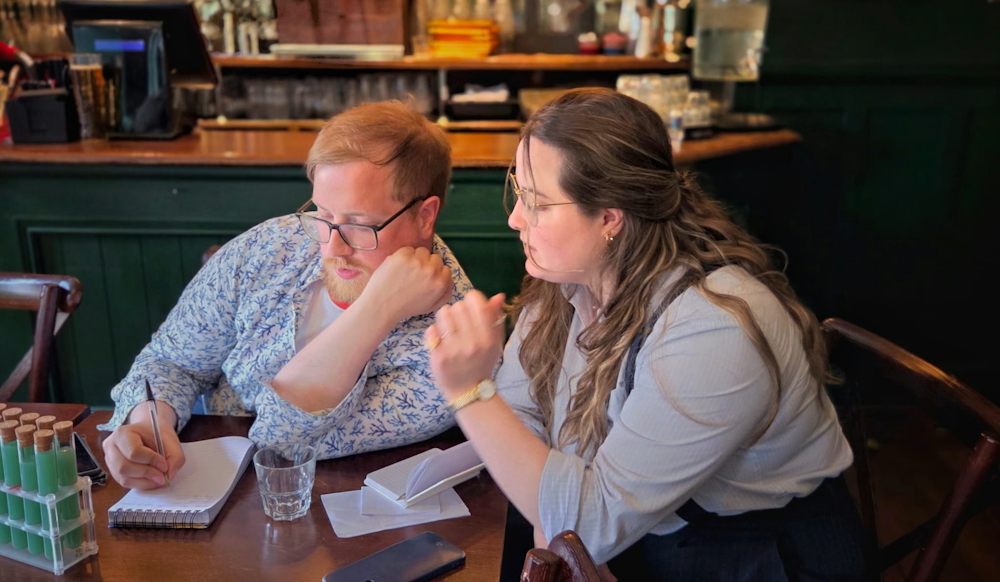
Over the course of the party, the players will exchange rumours, form alliances and investigate suspicious behaviour. Conversations happen naturally throughout the evening rather than at predetermined intervals.
The host keeps the game moving but doesn’t need to direct every conversation. They have two key functions:
- They keep track of time, making announcements at key points and when new evidence appears.
- They allow players to interact with their environment – if a player wants to try something unusual, the host adjudicates how that happens.
Achieving goals
As the party progresses, players will try to achieve their objectives.
These may be relevant to the murder, but may be something else entirely, as a freeform murder mystery is a collection of overlapping stories, some of which involve the murder.
Solving the mystery
As the evening progresses, players gather clues and gradually piece together what has happened.
At the end of the game, the host asks everyone to indicate who they think is the murderer. Then the host asks the detective to read the solution and reveal who the murderer really is.
(And if you’re a murderer? If at the end of the game, most players don’t think you are the murderer, then we would consider that a success – despite being revealed in the solution!)
Freeform vs round-based murder mystery games
There are several different styles of murder mystery party. The two most common are freeform and round-based games (like the boxed games you can buy in stores).
| Freeform | Round-based |
| Continuous play | Play divided into rounds or acts |
| Players choose who to talk to | Information revealed in stages |
| Conversations develop naturally | Players often pause between rounds |
| Flexible timing | Fixed structure |
| Encourages independent investigation | Everyone receives the scheduled clues |
| Players have a range of different objectives | Focused on solving the murder |
| The murderer knows who they are from the start | The murderer finds out at the end of the party |
| Numerous overlapping stories | Single story focused on the murder |
Neither approach is inherently better.
Some groups enjoy the structure of round-based games, while others prefer the freedom and spontaneity of continuous play.
If your guests enjoy conversation, deduction and discovering information for themselves, a freeform game may be the better fit.
(For a deeper dive, see Freeform v round-based murder mystery games.)
Do you need acting or improvisation skills?
Not at all.
One of the biggest misconceptions about freeform games is that players need acting experience.
In reality, most guests simply imagine how they would respond in different situations. Some people stay completely in character throughout the evening, while others dip in and out as they feel comfortable.
Instead, you just need to be able to talk to other players. (Although being able to lie when you are being questioned about your dark secret can help…)
Steve notes that when he plays a freeform murder mystery, he is still Steve. He doesn’t try to act – he just reacts naturally to what is going on in the party, based on what he knows about his character.
The aim isn’t to give an award-winning performance – it’s to enjoy creating a story together. (And maybe even solving the murder – although that’s obviously not something the murderer wants…)

What makes freeform games different?
Freeform games create a different atmosphere from more structured mystery parties.
Because players control their own conversations, every game develops differently.
You might spend half an hour uncovering a hidden conspiracy with one group before being interrupted by another guest with a completely different lead on a completely different story.
Unexpected discoveries, changing alliances and personal rivalries become part of the experience.
Many players say this makes the evening feel more immersive because they’re actively shaping the story rather than waiting for it to be revealed.
Who enjoys freeform murder mystery games?
Freeform games are suitable for many different occasions, including:
- Birthday parties
- Dinner parties
- Family celebrations
- Student societies
- Corporate team-building events
- Fundraising evenings
- Convention and club events
They work particularly well for guests who enjoy conversation, puzzles and social interaction.
Frequently asked questions
Is there a host?
Yes. The host prepares the game beforehand and keeps the evening running smoothly, but they don’t need to direct every conversation.
Some freeform murder mysteries allow the host to be a player and solve the mystery, but they must still prepare the game and manage the time. (They need to make sure they don’t read too much in advance!)
Can people who have never played before join in?
Absolutely. Most guests pick up the format within the first few minutes.
In fact, freeform murder mysteries are a great way to introduce new people to an established group as the mystery gives everyone a common topic of conversation.
How long does a game last?
Most freeform murder mystery games last three to four hours, although this varies between games.
Read more here: How long does a freeform murder mystery party take to play?
Can I play with large groups?
Yes. One advantage of freeform games is that conversations happen simultaneously, making them well suited to larger groups.
Our largest game is Murder at Sea, and if you include the free extra characters created by our customers, works for up to 40 players.
Ready to host your own?
Now that you know how freeform murder mystery games work, the next step is choosing the right game for your group.
Our Choosing a murder mystery game page helps you to decide which games to host by subdividing our games by theme (e.g. pirates, wild west, 1920s), number of players (hint: smaller games are easier to run if this is your first game), and occasion (e.g. Halloween or Christmas).
Good luck, and tell us all about it!