
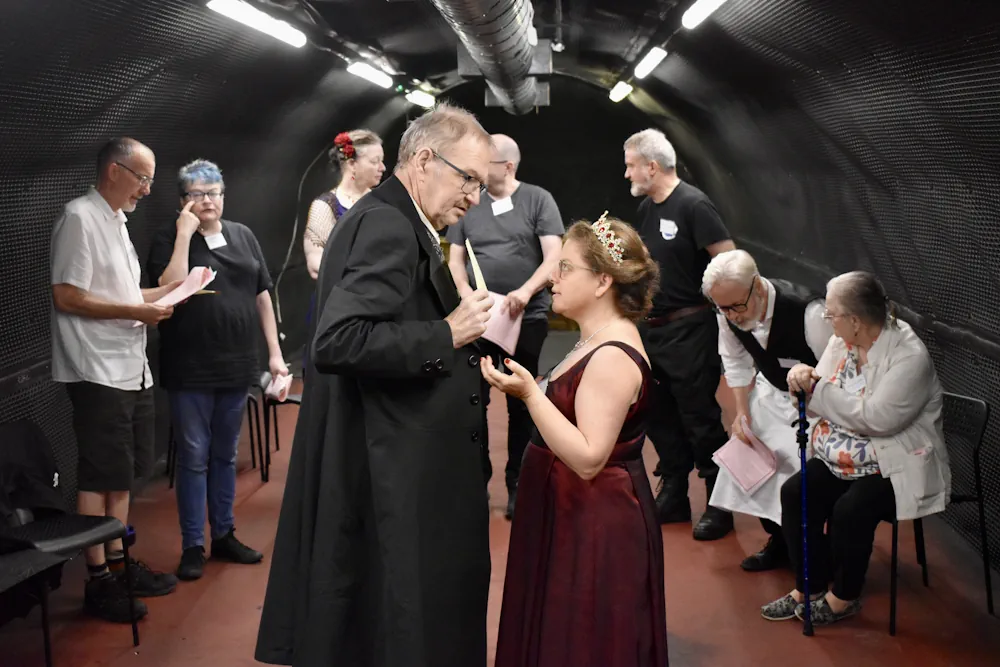
Why Freeform Games?
In short, because in 2001, when Mo and I started Freeform Games, we wanted to bring to a wider audience a type of roleplaying game that we knew as a “freeform”.
“Freeforms” as a term had been kicking around the UK roleplaying scene for about ten years by that point. The games were much like the murder mysteries we publish:
- A single location
- Several different storylines all at once – few players will experience all of them
- Detailed character backstories
- Characters have their own objectives that bring them into conflict with each other
- Players are free to decide what their characters do and who they interact with
- Usually three or four hours long
- Simple rules (if any)
They were most often played at conventions, because that’s the easiest place to find enough gamers interested in playing one.
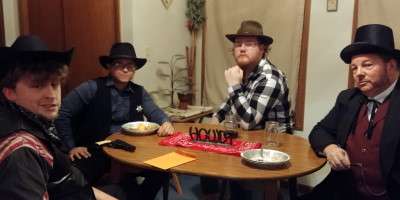
So, is a freeform a larp?
Yes, sort of. Larp (originally LARP) means “live action roleplaying game,” and many of the best-known larps involve players dressing up in fantasy costumes and hitting each other with rubber weapons. (I simplify greatly – they’re much more sophisticated than I make them sound.)
Freeforms are a little different – they’re often set in the real world or historical settings, and if there is any combat, it is simulated.
(This style of larp is also known as a chamber or parlour larp, depending on where you live. The style has developed in several different places. In the UK, the term “freeform” seems to have been adopted after the publication of Morgana Cowling’s The Freeform Book.)
Freeforms are great fun!
I loved playing (and running and writing) freeforms. They were so much fun, and I realised that they were a great way for non-gamers to try out roleplaying – particularly if they had a historical or modern-day setting.
And as murder mystery parties were already a known quantity, if we included a murder in our freeform, then we could call it a murder mystery game.
(It is ironic, then, that our first game, Death on the Gambia, doesn’t have a murder in it.)
And although they were marketed as murder mysteries, our games were (and are) freeforms.
Why “freeform” is a good name
Unlike a more scripted murder mystery, players aren’t simply waiting for the next round or revelation. They have objectives, information, secrets and relationships, and then they’re largely free to decide what to do with them.
Different groups – and even different players in the same game – can therefore have very different experiences.

Traditional murder mystery parties aren’t only about the murder
I played a few of the boxed “How to Host a Murder” parties, and my takeaway was that while they were fun, they were mainly an excuse to get together with friends, have a meal, and be slightly silly.
There was a murder, yes, but I wanted more. Alongside the murder mystery, I wanted other plots and more freedom for the players. In short, I wanted more freeform in my murder mystery parties.
Freeform murder mystery parties – more than just murder
So that’s how we designed our freeform murder mystery parties.
Yes, there’s a murder, and anyone can try to solve it. We make sure there’s a solvable clue trail – although the clues aren’t always obvious.
But the murder is often a situation around which we hang a number of other storylines. Our games are so much more than solving the murder – there’s so much more going on.
That’s a mark of what I think of as a good freeform. There are parts of the game you may never see – storylines your character never interacts with.
And that’s where the ‘freeform’ part really comes in. There are parts of the game you may never see, characters you may barely interact with, and storylines that may unfold very differently depending on what the players decide to do.

Freeform Games
And that’s why we called our company Freeform Games. It was the obvious choice.
Twenty-five years later, we’re still making freeforms. We just happen to call them murder mystery games because that’s a more useful description when you’re trying to explain them to everyone else.




0 Comments